
Inheritors - Intro and Prologue
Introduction and New Prologue

Hi Lucas’ Lil Library library-card holders!
Thank you for being here. Please let me know what you think or suggest things for me to write on and publish. I’m also game for collaboration, always.
In this Inheritors series, I’m going to publish in episodes the full transcript of this piece. In this first section, you’ll find several essays, and guiding thought intended for the future producers of this play.
This piece means the world to me. <3
Inheritors
An adaptation of Susan Glaspell’s 1921 Play
By Lucas H. Reilly
U.S. COPYRIGHT, ©
Land Acknowledgement and call to action
This play takes great concern about the land and its preservation and use for the potential betterment of humankind. The land on which the play is set is land of the Očhéthi Šakówiŋ (Seven Council Fires/Sioux), Myaamia, Kiikaapoi, Peioria, Oθaakiiwaki‧hina‧ki (Sauk), Meškwahki·aša·hina (Meskwaki/Fox), among other Indigenous Nations and Peoples throughout the history of this continent.
The play concerns particularly the history of the Sauk and Meskwaki on this land. After migrating far south from their original lands in the Northeastern Woodlands, avoiding colonizers a hundred years earlier, these two peoples found themselves allied still, living along the great Mississippi. This play tells some of the tragedy of their violent removal from this more recent home, but doesn’t begin to tell the whole story. Just 189 years ago, the land on which this play is set was the home of the Sauk and Meskwaki, and it was forcibly taken from them by the US Government and European settler-civilians. This fact is inextricable from this play.
In some parallelism with this story, the Meskwaki Nation was able to secure a future for their people in part by the purchase of private land from the United States as well as European settlers in Tama County, Iowa. More information on the recent history of this remarkable and resilient nation can be found at meskwaki.org.
Please take a moment to consider the land of the play, and the land of this continent, and the peoples who stewarded it long before Europeans brought plague, famine, war, climate destruction, white supremacy, and private land ownership to it.
Every performance of this play must include an Indigenous land acknowledgement of where the play is rehearsed and performed, and communities must consider how to give back to their local Indigenous communities through the production of this play. It is my intention that a portion of the proceeds gained by this play over the years will be given to the Meskwaki Nation, and I look forward to finding like-minded producers who can help me realize this vision.
Introduction
This adaptation seeks to usher an underappreciated and urgent American History play into a new millennium. To do battle against the great injustices of our time, we’d do well to consider how we got here. The American mythology of Manifest Destiny has been planted and regrown generations over by the colonizer. It is a dangerous weapon. Glaspell’s play interrupts that mythology and begins to dismantle it; at the same time it looks at the state of America in Glaspell’s own time and wages intellectual battle in the continuous war against the oppression of immigrants, Indigenous peoples, Black and Brown peoples, and any citizen who may speak or act against the colonizer’s system. These are issues core to the history of this land; to this day the systems of colonial power have never been brought to account.
When this play was written, it was set in the present day--1920 post-war Iowa. One of the most striking impressions that this play made on me when I first read it almost a hundred years later is how present the actions of the 1920 timeline feel. The protest we hear of in the play resembles protests that I’ve been a part of and seen--this play cries out some of the same things I’ve heard and cried out at these protests. This play takes on colonialism, police brutality, the horrors of the American prison system, the fear of Otherness in skin color, origin and thought. At the same time it questions who is the rightful keeper of the land on which these intellectual wars have been fought since the arrival of Europeans in North America. It provides us “this touch with the life behind us”, yet its heart beats in time with today because our existential issues have still not been addressed. For this reason, in this adaptation I choose to reorder the action of the story, beginning in 1920. In doing so, I attempt to combat the many years of the indoctrination of Manifest Destiny Mythology, and provide a time-travel-expressway from 2020 to 1920, and then back to 1879. Then, action weaves back and forth between the two time periods. The lofty aims of Silas Morton are juxtaposed more directly with the deadly compromises of Felix Fejeveray II. The question of “who the land would have preferred” is juxtaposed with Madeline’s choosing to refuse the riches gained of that same land and Ira’s twisted obsession with perfecting the use ordained by the settler on the land (corn). The whole complex picture is painted more clearly, and the final moment is Glaspell’s Act I finisher, “to the dreams of a million years!” and with the question of “Look at the land we walked in and took! Was there ever such a chance to make life more?”. I hope this retelling will provide Americans an opportunity to put themselves in 1879 and look forward at contemporary America and what it has become. Below I’ll detail the major tools used in adapting the original to these purposes.
A New Prologue
I’ve included the action of the protest outside the library at Morton College. This action is implied by Glaspell in the original, and was left out of the stage action in 1921 perhaps due to the limitations of the Provincetown Players’ stage and staging capabilities (and even perhaps a fear of censorship). Furthermore, seeing this action will help achieve one of the major goals of this adaptation: To provide this touch with the life behind us, and to illustrate how the issues tackled by this play (police brutality, the suppression of anti-establishment anti-Colonial anti-oppressive voices, fear of the Other, Colonial oppression of Native, Foreign, Black, and Brown peoples, etc.) run deep into our past and often looked the same as they do today. The goings on at Morton College (and other colleges vying for State funding just after WWI) are part of a particular pivot-point in the history of US capitalism and imperialism; by showing the actual protest Glaspell implies, we help our audience into this history and connect it with our present reality.
Action beginning in 1920
In this adaptation, the action begins in 1920, unlike Glaspell’s original which begins in 1879. The purpose of this change is to connect the play more directly with the present and to allow a bridge from our present to the action of 1879. It’s also to enhance the ambiguity around Glaspell’s message about the foundation of Morton College. In Glaspell’s original she comes down on the side of the inspired white settler with deep connections to the Native-Born and the Foreign-Born; but the history surrounding the foundation of what are ultimately Euro-Colonial colleges on Indigenous land is undeniably just that--a further movement of Euro-Colonialism. In the 2020s, by looking backward through the lens of the 1920s, our audience will better be able to understand how the machine-like force of the Euro-Colonialism of North America poisons and pimps to its purposes even the beautiful ideals of Silas Morton. Silas says, in communing with Black Hawk about the hill on which the college is built.
“...it’s more yours than mine, you had it first and loved it best. But it’s neither yours nor mine,--though both yours and mine. Not my hill, not your hill, but -- hill of vision, said I to him. Here shall come visions of a better world than was ever seen by you or me, old Sauk chief.”
This reverence for the land and admission that the land is more belonging to Indigenous peoples than settlers is laudable, but seen through the lens of 1920 it is somewhat spoiled, as we see what colonial development (regardless of its sometimes high ideals) ends up doing to Free Thought, and those most in need of support from their higher institutions and organizations. This is a central theme in the original play; by reordering the play, this message is shored up and our feelings about Silas Morton, Felix I, and the foundation of the college are further made ambiguous through knowledge of the central conflict of Glaspell’s original Act II.
Interspersing of action over the two timelines
My inspiration for interspersing the action of Glaspell’s original Acts II and III with Act I is mused by two closely related sources. First, I agree with Linda Ben-Zvi in her analysis of the reviews of the original production (see Susan Glaspell: Her Life and Times for some of those exact reviews/thoughts) that Glaspell with Inheritors “had introduced a new historical drama form, never before seen in America”. This play is remarkable in the way it presents history and draws connections between generations of American experience. By interspersing the action, I aim to strengthen that connection, and help audiences 100 years later draw stark connections between Colonialism, Capitalism, and the oppression of marginalized groups. Secondly, I also hope to celebrate Glaspell as an innovator in a new way; she is a writer without whom our theatrical tradition would not be so rich in literature, truth, and humanity. This adaptation seeks to highlight and laud her contributions while at the same time challenging her work by lending some of our own perspective and feeling.
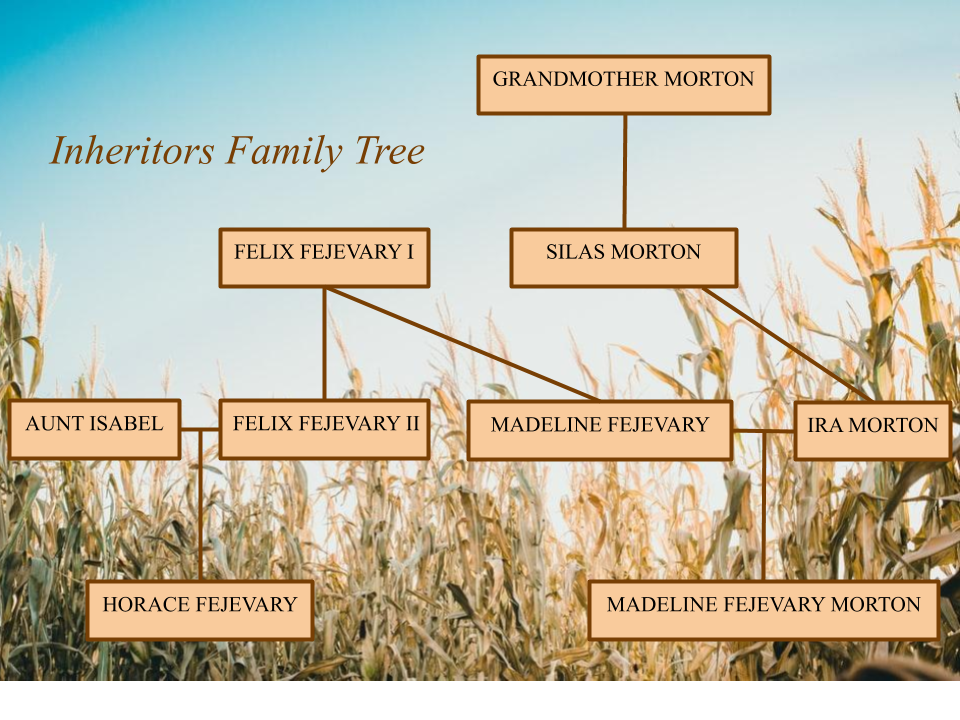
CHARACTERS (in order of appearance):
Protestors
Police
Horace Fejevary
Atma
Madeline Fejevary Morton
Senator Lewis
Felix Fejevary II (1920)
Grandmother Morton
Smith
Felix Fejevary I
Silas Morton
Aunt Isabel
Felix Fejevary II (1879)
Professor Holden
Blackhawk
Harry
Ira Morton
Emil Johnson
Casting Suggestions
Production teams should cast and crew the play in a reflection of diversity in their community. Indigenous professionals should be employed, paid, and their vision and voice should be considered more loudly than the playwright. Immigrant professionals should be employed, paid and their vision and voice should be considered more loudly than the playwright. Lived experience should be considered paramount to expertise when making decisions to tell the story, especially where the story concerns protests, prisons, police, Indigeneity, immigration, and war.
The play can be performed by as few as 8 actors. See below.
ACTOR 1 18-40
Atma: A student of Morton College from India active in the protest against Fred Jordan’s imprisonment.
Smith: A young hotshot salesperson with strong persuasive skills.
Harry: A librarian.
Fred Jordan: Former Morton College student imprisoned for being a conscientious objector.
ACTOR 2 45-80
Grandmother Morton: The first white woman to settle along this stretch of the Mississippi. She has known that which was pioneer life.
Aunt Isabel: A society woman, strong of heart, Felix Fejevary II is her husband. She has great influence on the culture of Morton College.
Grandmother Morton and Aunt Isabel could be within 10-15 years of each other in age, but the pioneer life has weathered Grandmother significantly.
ACTOR 3 30-45
Silas Morton: The vital American farmer, son of Grandmother Morton. He fought for the Union. A man of vision and connection to the earth.
ACTOR 4 35-50
Felix Fejevary I: An expatriate Magyar from Hungary after the failed 1848 Revolution. He lost his arm fighting alongside Silas Morton in the Civil War.
Professor Holden: A transcendentalist professor who supports conscientious objectors and opposes Fred Jordan’s imprisonment.
ACTOR 5 18-25
Felix Fejevary II (1879): The brilliant 18 year old son on the rise. He attends Harvard.
Horace Fejevary: The privileged son of fortune and opportunity. His grandfather was an immigrant, but he is “one-hundred-percent American”.
Ira Morton (1879 Flashback): The son of Silas Morton when he was still a boy.
Emil Johnson: A self-assured Swedish American farmer.
ACTOR 6 18-25
Madeline Fejevary Morton: The granddaughter of Silas Morton and Felix Fejevary I. Her mother died in childbirth, she lost her brother in WWI, and firmly stands against Fred Jordan’s imprisonment.
ACTOR 7 45-65
Felix Fejevary II (1920): The son of an immigrant. He is a Harvard graduate and the financial leader of Morton College. He is trying to procure state funding to secure the future of the school.
ACTOR 8 30-65
Senator Lewis: The conservative Midwestern senator. “One-hundred-percent American”.
Ira Morton: Silas Morton’s son, Madeline Morton’s father. Ira is like something touched by an early frost. He has been obsessed with bettering and protecting his corn since the passing of his wife in childbirth.
Further notes for Production Teams
This adaptation time-travels mid-scene. Sets should allow for quick transitions to new time/place, and creative teams should think about how to use these moments to connect time, space, and idea. No blackouts between scenes. The two eras are connected to each other and to ours. At the end of the play, Madeline transcends time and space--she is in both places, and everywhere, and nowhere all at once. She’s out under the stars with Silas, Fejevary, and Blackhawk in 1879, she’s in the prison cell in 1920, she’s in the streets fighting fascists today.
Productions should be wary of falling into the White Savior trope particularly in the telling of Madeline’s story. Her relationship to Fred Jordan and Atma and Gurkul should be considered at length. The play centers Madeline and indeed her allyship; but Madeline fails to save anyone. Her story goes to show that when one privileged citizen pits themself against any Establishment, it is likely that it will not be enough to change the Establishment, only to cast the rogue into the oppressive systems built usually for the non-privileged. But like corn blowing in the wind, fertilizing a distant field, maybe her self-sacrifice will inspire a new generation of Americans to consider the horrors of our past and present, and push forward to create a better world.
In the original play, characters use the word “Indian” to refer to the peoples Indigenous to the land now occupied by the United States and other colonizer societies. Where this word is used to describe events and peoples specific to this section of the Mississippi valley at the time, in what is now the border between Iowa and Illinois, I have substituted the word “Indian” with “Sauk”, and “Meskwaki”. The land occupied by the Sauk and Meskwaki on the Eastern bank of the Mississippi was the central conflict that drove the Blackhawk War of 1832. The history of Blackhawk himself and the war of 1832 are irremovable from this play; I’ve chosen to use the names of the Indigenous Peoples who were the stewards of this continent’s land before the arrival of Grandmother Morton. By doing so, I hope to go even deeper into the question of who the land prefers and what is its rightful use. However, in instances where the word “Indian” or “red” are used to refer to Native Peoples in a general sense, I have kept the words. Though they are words rooted in an outdated European colonizer’s understanding of the world and words that can cause harm, these are the words that the Mortons and Fejevarys and Glaspell herself used to describe Indigenous Peoples, and a word that has been reclaimed by many Indigenous Americans.
I opt not to change this because I don’t intend to raise the white colonizers in this story to a level of awareness and language that they indeed did not possess. I don’t want to glorify or make white saviors out of the Mortons--they certainly weren’t that. The Mortons and the society they stood for killed Native people, and they accepted the land from the U.S. government thereafter. The Mortons’ connection to Blackhawk is profound and enlightening to Silas. His attitude toward land begins to question consumptive colonialism, but he and the others in this story were no saving grace to the people who once oversaw this land and were thereafter forced off of it and exploited for generations.
Thanks for reading this far, truly.
PROLOGUE
Outside the library of MORTON COLLEGE, October of 1920. This is the fortieth anniversary of its founding. A group of student protestors are gathered, with signs and musical instruments. Their signs read “FREE FRED JORDAN”, “FREE GURKUL SINGH”, “FREE GENE DEBS”, “SEDITION ACT: UNCONSTITUTIONAL”, “HINDU AMERICANS ARE AMERICANS” “LIBERTY AND JUSTICE FOR ALL” “MORTON COLLEGE FOR ALL”. Drums thump, horns blare out of tune, and the protestors chant. Some other students stand watching from the steps of the library.
PROTESTORS
FREE FRED JORDAN! FREE FRED JORDAN! FREE FRED JORDAN!
ENTER the counter protestors, with a few police, led by HORACE FEJEVARY. HORACE points to the protestors and runs behind the police. They are strapped with billy clubs, handcuffs, a gun or two, blowing whistles and shouting.
POLICE
GO! THIS IS AN UNLAWFUL DEMONSTRATION! IF YOU DON’T DISBAND--
They approach the protestors menacingly as they continue their chant.
PROTESTORS
FREE FRED JORDAN! FREE FRED JORDAN!
ATMA makes his way to the front of the demonstration and steps away from the horde. They kneel in front of the front line of protestors. There is a pause as the Police push to the front. The largest policeman begins to brandish his billy club when MADELINE FEJEVARY MORTON and several other students run forward, and throw themselves between Atma and the police. It’s messy but they manage to drive back the police slightly. Madeline begins the chant once more.
PROTESTORS
FREE FRED JORDAN! FREE FRED JORDAN! FREE FRED JORDAN! MORTON COLLEGE IS FOR ALL!
ENTER SENATOR LEWIS, escorted by more police officers. He surveys the scene, shakes his head, and is escorted into the Library, swarmed by the protestors. Horace stands looking smugly on at the action.
HORACE
GET EM!!! There’s a reason they give you those clubs!!
Madeline and Atma chase him and a few of his cohorts off in the other direction.
PROTESTORS
Over here! They’ll be able to see us from the windows in the library! Come on!
The protestors run off. END SCENE